This course is about how to teach students to speak English well.
Intermediate and advanced English students often lack a coherent sense of how the verb tense system of English works. Many students feel intimidated by the number of forms they meet and sometimes feel that they don’t have criteria for choosing which form to use. The way the forms of a verb relate to each other remains a mystery. Some students occcasionally try to use verb forms which don’t exist.
The course will show you how to teach your class of students:
- to be confident in using any of the forms of any verb when speaking
- to be skilled in knowing which forms to use for any context
Once a class has some experience with working this way, you and they will have an invaluable tool to use when you are teaching any other aspect of the language. In particular, this verb tense system is essential for anyone wanting to run a course where the content comes from the students—such as a Dogme-style course or a Class Conversation course.
This technique avoids talking about grammar since this can be confusing for students. Instead, we use visual techniques which eliminate the need for grammar labels like ‘the present perfect’ or ‘the past progressive’, while still enabling the teacher to make sure students’ sentences end up correct, true and accurate. The technique is built around the students expressing themselves, talking about whatever is uppermost in their minds, real things from their own lives—their work, ideas and histories. They do most of the talking and the teacher talks very little.
Students like working this way
Students like working this way because these techniques help them to solve one of the key sources of insecurity they sometimes feel when speaking English—which verb forms to use in which situation. They also like talking about their own lives and finding out about the lives of their classmates.
Overview of the course
You will learn how to:
- get your class to generate a visual image of the English verb system as a whole
- explore with the class ways of talking about events from their lives through the ‘lens’ of the English verb system. A key part of this will be exploring ‘triggers’—words or short expressions which ‘trigger’ the use of one or more of the verb forms
- get the class to generate many example sentences orally
Here’s a picture of the visual model being used in an actual class online – the teacher and the students have laid out the visual model of the English Verb system as a whole and using it to help the student talk more accurately and fluently about things from his everyday life.
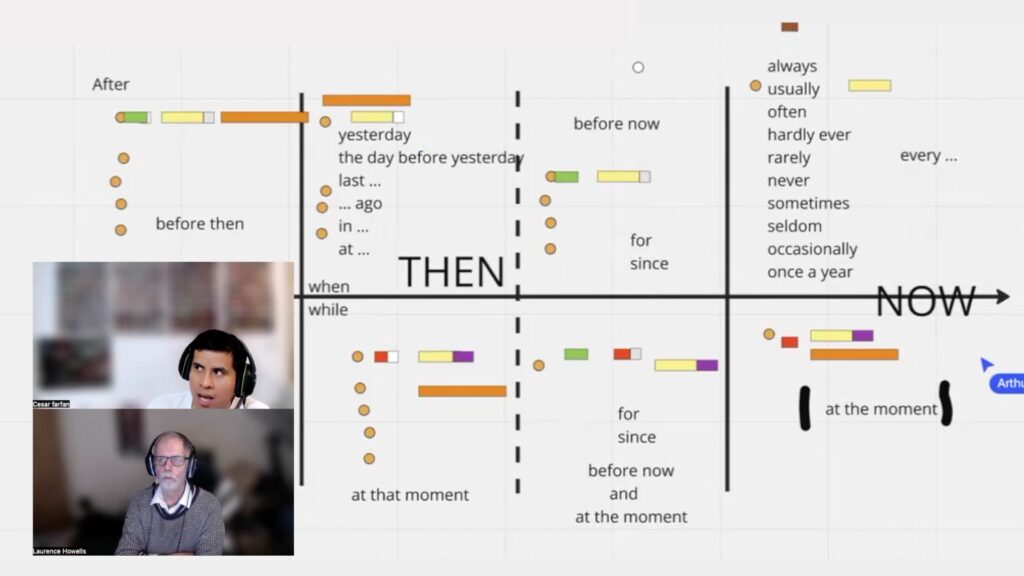
The course contains 70 short lesson, most of them containing short videos (45 videos in total, most of a few minutes or so), and 5 discussion forums in which you can ask questions, seek advice or comment on what you’ve seen and read. The course is structured into five weekly blocks of lessons and each week is supported with the opportunity for a video conversation with an experienced teacher (see below). You can review and rewatch all of the lessons as many times as you want.
Teaching without rules and without text-books or materials
In this way of working, it is the examples themselves which teach the students, helping them to develop a comprehensive and precise inner feel for the system and how to use it to express whatever they want to say. This is, after all, probably why they came to a course, and therefore the most important thing they need to learn in order to use English confidently, fluently and expressively.
What’s more, since all the content comes from the students themselves, the teacher needs no text-book, materials or handouts: students simply talk about their lives, their work, what they do every day. In this way, extraordinarily rich personal conversations are generated in these classes. And the teacher needs no preparation in advance of each lesson.
What kind of students is this technique useful for?
This technique was developed for intermediate or advanced students who already have some English. It was developed in France at the Centre de Linguistique Appliquée, Université de Franche-Comté. The technique has been used very successfully with small and large classes—the largest we know of had more than 50 students. The technique is for teaching students to speak the language—very little writing is used—but, of course, most of the students who come to courses do so because they have already learned to write and now need the spoken language.
Support
Included in the course fee are five weekly discussion and support sessions by video call with one of the course authors. This means you will get the chance to ask any questions, take advice from experienced teachers and explore in depth how to apply the learning from the course in practice in the classroom. To book your video call email us at any time.
Curriculum
- 5 Sections
- 68 Lessons
- Lifetime
- Week 1: Introduction and setting out the forms14 ItemsAn introduction to the technique and the first stage of working with a class on it
- 1.1W1.1 What is the English Verb Tense system? An overview
- 1.2W1.2 No 1—‘I work’
- 1.3W1.3 No 2—‘I worked’
- 1.4W1.4 No 3 & No 4—‘I am working’ and ‘I was working’
- 1.5W1.5 Which students do you use the Verb Tense System with?
- 1.6W1.6 No 5—‘I have worked’
- 1.7W1.7 No 6—‘I’ve been working’
- 1.8W1.8 What are we aiming for?
- 1.9W1.9 Pause the video
- 1.10W1.10 No 7 & No 8—‘I’d been working’ and ‘I’d worked’
- 1.11W1.11 Key to the colours
- 1.12W1.12 What to do before the first time you use this technique
- 1.13W1.13 Discussion forum: Week 1—Introduction and setting out the forms
- 1.14W1.14 Week 1 Conclusion
- Week2: Relating the forms to students' lives—starting simple14 ItemsStudents start saying things about their lives and connecting them with the verb forms
- 4.1W2.1 No 1 & No 2—Introducing ‘triggers’
- 4.2W2.2 Checking what the student has retained
- 4.3W2.3 No 3—‘Yesterday I came back home around 5pm’
- 4.4W2.4 No 4—Some more complex sentences
- 4.5W2.5 No 5—More about the student’s life
- 4.6W2.6 It shouldn’t be mechanical
- 4.7W2.7 No 6—Starting with ‘At the moment’
- 4.8W2.8 No 7—The student introduces ‘… but I have applied’
- 4.9W2.9 Pause the video
- 4.10W2.10 No 8 & 9—Exploring more of the student’s life
- 4.11W2.11 It’s the examples that do the teaching
- 4.12W2.12 Do some practice!
- 4.13W2.13 Discussion forum: Week 2—Relating the forms to students’ lives—starting simple
- 4.14W2.14 Week 2 Conclusion
- Week 3: Relating the forms to students' lives—expanding a little11 ItemsStudents gradually get more confident with verbs and can expand what they choose to talk about
- 5.1W3.1 No 10—Reviewing the work so far
- 5.2W3.2 No 11—More work on ‘At the moment’
- 5.3W3.3 No 12—Exploring ‘Before now and at the moment’
- 5.4W3.4 Teaching without rules
- 5.5W3.5 No 13 & No 14—Generating more sentences
- 5.6W3.6 The irregular verbs
- 5.7W3.7 ‘After’ / ‘When’
- 5.8W3.8 The verb ‘to be’
- 5.9W3.9 Do some practice!
- 5.10W3.10 Discussion forum: Week 3—Relating the forms to students’ lives—expanding a little
- 5.11W3.11 Week 3 Conclusion
- Week 4: Exploring further17 ItemsTalking about the future, adding the modals ... taking the students as far as possible
- 6.0W4.1 No 1—Talking about the future
- 6.1W4.2 No 2—Using ‘will’
- 6.2W4.3 No 3—Using ‘would’
- 6.3W4.4 No 4 and No 5–Starting with ‘if’
- 6.4W4.5 No 6—Exploring the modals
- 6.5W4.6 No 7—‘I was accepted …’
- 6.6W4.7 Using the verb system in a ‘Tell me’ lesson
- 6.7W4.8 Exploring even further—the passive forms
- 6.8W4.9 Another student, another teacher: starting to talk about the future
- 6.9W4.10 Another student, another teacher: starting with the modals
- 6.10W4.11 Another student, another teacher: ‘While I was sleeping …’
- 6.11W4.12 Another student, another teacher: ‘I should’ve done the shopping yesterday …’
- 6.12W4.13 Another student, another teacher: ‘If I’d had the money …’
- 6.13W4.14 Another student, another teacher: ‘If I were rich …’
- 6.14W4.15 Do some practice!
- 6.15W4.16 Discussion forum: Week 4—Exploring further
- 6.16W4.17 Week 4 Conclusion
- Week 5: Things to think about as you work12 ItemsGoing beyond the specific techniques for working with the verb tense system
- 7.1W5.1 Giving students time to think
- 7.2W5.2 Some more thoughts about triggers
- 7.3W5.3 Students need an emotional connection to what they say
- 7.4W5.4 Avoiding stereotyped and impersonal language
- 7.5W5.5 More about the modals
- 7.6W5.6 What happens if a group of students don’t get very far
- 7.7W5.7 After a while the students won’t need the diagram
- 7.8W5.8 The four stage model of learning
- 7.9W5.9 Some reading
- 7.10W5.10 Next steps
- 7.11W5.11 Discussion forum: Week 5—Things to think about as you work
- 7.12W5.12 Conclusion and feedback

 English (UK)
 Français